Key Takeaways
- Challenge: Rising substrate costs and volatile energy markets heavily pressure the profitability of modern biogas plants.
- Solution: ProGasLin acts as an economic tool, increasing efficiency and energy yield per tonne of input in the digester.
- Result: Significant profit maximization through increased energy output or reduced substrate input, with a very low break-even threshold.
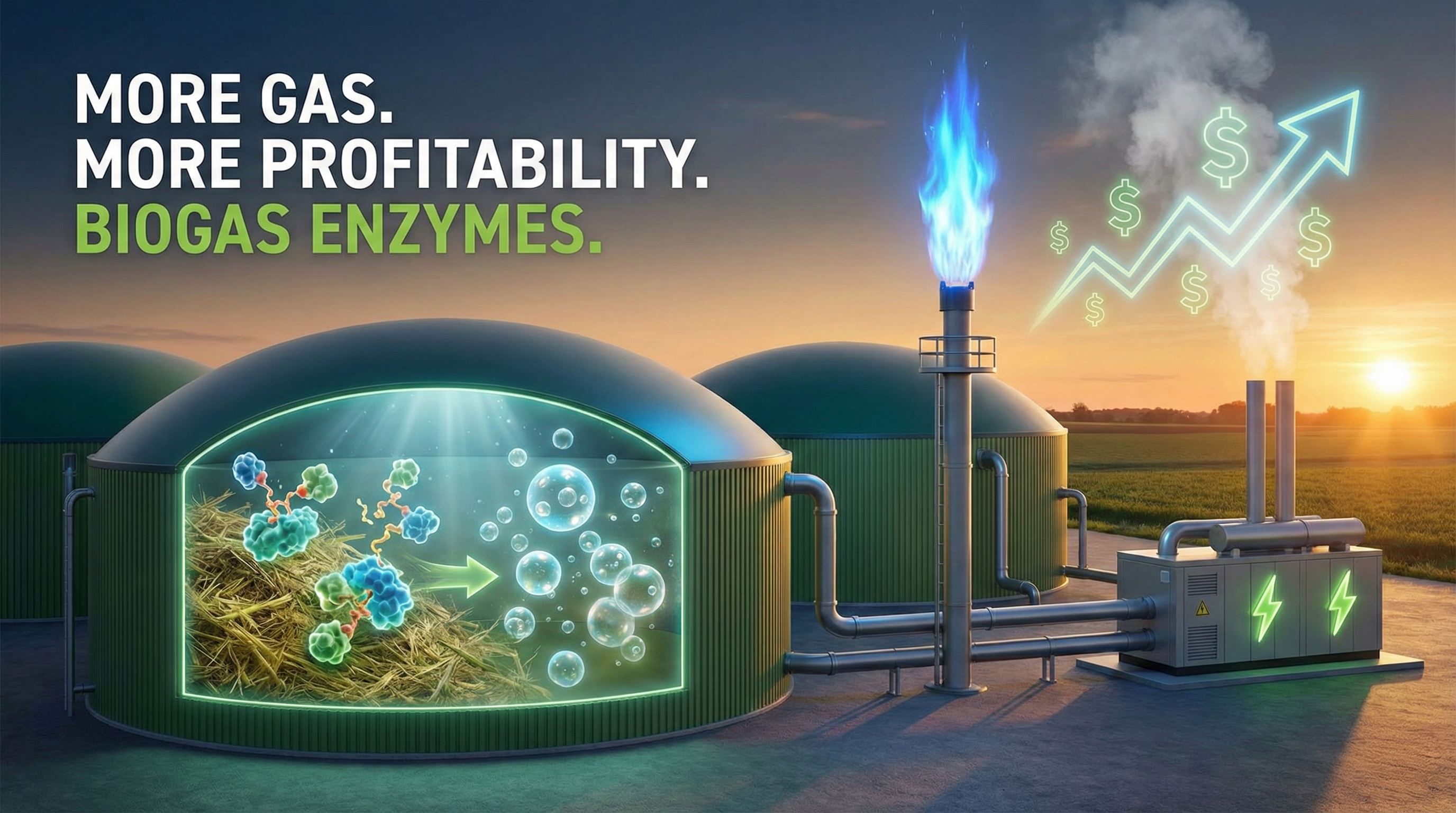
Biogas plant operators do not make decisions out of theoretical interest, but on the basis of clear economic indicators. Rising substrate costs, the increasing use of high-fiber feedstocks, and volatile energy markets mean that the economic success of a biogas plant today depends primarily on one factor: the energy yield per tonne of input material. Against this background, ProGasLin is not a conventional additive, but an economic tool designed to increase efficiency in the digester.
The Economic Starting Point of Modern Biogas Plants
A typical agricultural biogas plant with an electrical output of 500 kW produces around 12,000 kWh of electricity per day in continuous operation. The main cost driver is not technical operation, but the substrate. Based on common practical calculations, the full costs for renewable raw materials such as maize silage, whole-crop silage (GPS), grass silage, or CCM often range between EUR 35 and EUR 45 per tonne of fresh mass – including cultivation, harvesting, storage, and logistics.
With a realistic substrate mix of around 25 to 35 tonnes of input material per day, this results in annual substrate costs in the mid six-figure range. Every percentage point improvement in substrate utilization therefore has a direct and immediate impact on plant profitability.
ProGasLin: Clearly Defined Costs, Measurable Impact
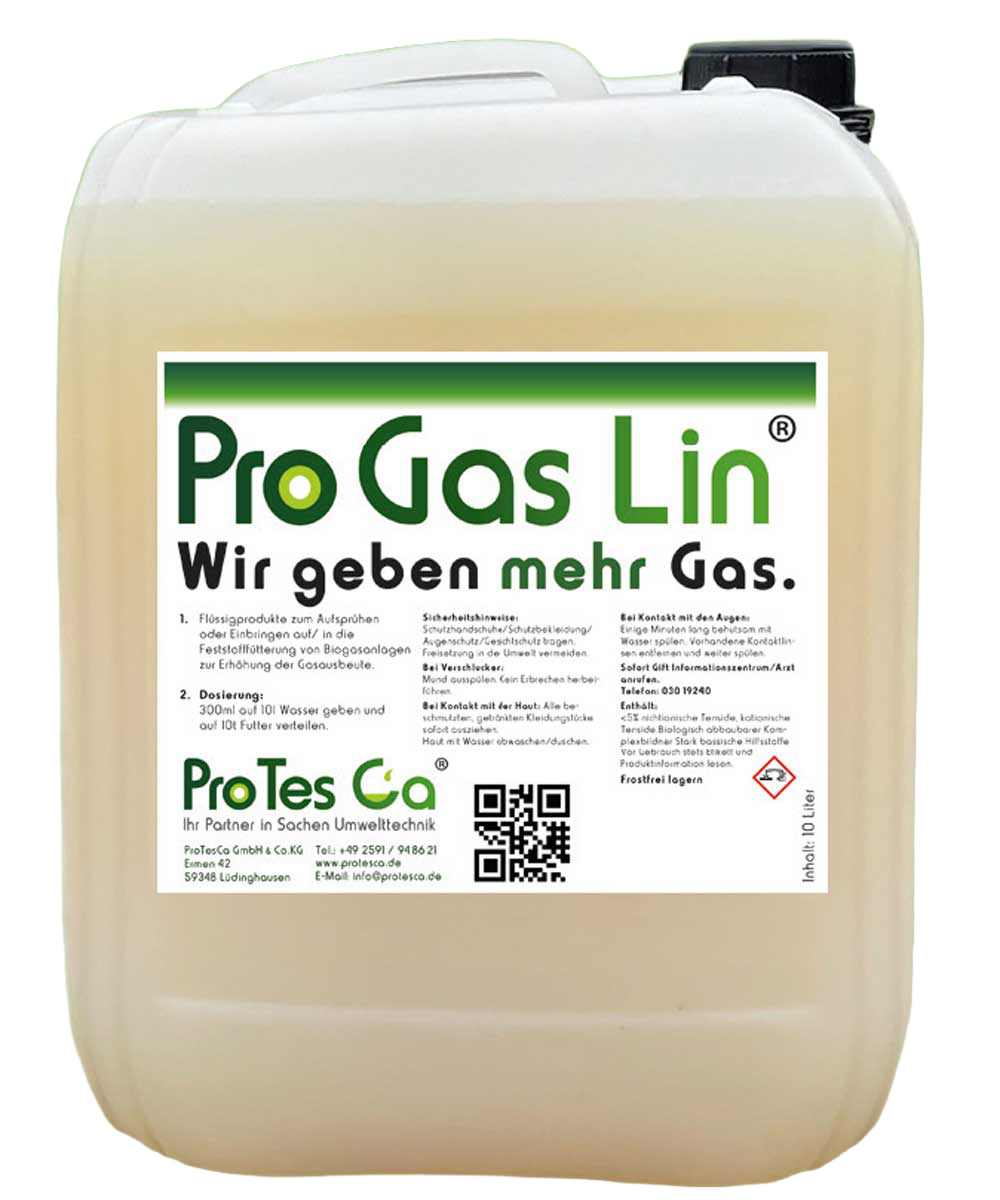
ProGasLin is applied as a highly concentrated product at a dosage of 30 ml per tonne of substrate. For a typical 500 kW plant, this results in a consumption of approximately 25 to 30 liters per month.
At a current net price of EUR 39.90 per liter, annual product costs range between EUR 12,000 and EUR 14,400. This corresponds to approximately EUR 1.20 per tonne of substrate used. This figure is decisive for any economic assessment.
Break-Even Analysis: When Does an Economic Benefit Arise?
The break-even point of ProGasLin lies well below the often-discussed double-digit efficiency improvements.
With average renewable raw material costs of around EUR 40 per tonne, a reduction in input of only about 3 percent is sufficient to fully offset the product costs. Alternatively, depending on the actual electricity price achieved, an additional yield of approximately 1 to 2 percent of annual electricity production is enough to reach economic neutrality. Anything beyond this threshold directly increases profit.
Practical Example: Profit Impact at 500 kW
If a 500 kW biogas plant achieves an efficiency gain of 10 percent through improved substrate utilization, two economic scenarios arise:
- 1. Same Input, More Energy: Additional energy production amounts to approximately 1,200 kWh per day or around 438,000 kWh per year. Depending on the electricity price, this corresponds to additional annual revenue of EUR 65,000 to more than EUR 100,000.
- 2. Same Energy Output, Less Input Material: If the same energy output is achieved with approximately 10 percent less renewable raw material input, conservative calculations show annual savings of around EUR 35,000 to EUR 50,000 on the substrate side alone.
In both cases, these effects are offset by annual ProGasLin costs of approximately EUR 12,000 to EUR 14,400.
Scaling: Why Larger Plants Benefit Disproportionately
The economic logic of ProGasLin scales linearly. In a 1 MW biogas plant, input and energy volumes double. Accordingly, absolute savings and additional revenue potential also double, while the relative break-even threshold remains almost unchanged.
Larger plants, especially those with a high proportion of high-fiber substrates, often benefit significantly from improved hydrolysis and more stable process control.
Additional Economic Side Effects
In addition to direct profit effects, further economic benefits are frequently observed:
- Reduced wear on agitators due to more homogeneous substrate behavior
- A more stable biological process with fewer interventions required
- Lower effort and costs for troubleshooting and process corrections
These effects depend on the specific site and plant configuration, but they contribute positively to operating costs over the long term.
Conclusion: Efficiency Determines Profitability
The economic reserve of modern biogas plants does not lie in higher feeding rates, but in better utilization of existing raw materials. ProGasLin addresses precisely this point: with clearly calculable costs, low dosage rates, and an economic logic that can be measured in euros per tonne and euros per year.
For biogas plant operators who view their plant as an entrepreneurial investment, efficiency in the digester is one of the most effective levers for sustainable profit maximization today.